
Construction
Where Construction Debris Actually Goes in Tangipahoa Parish
Most contractors never think about where the container goes after it leaves site. Understanding the disposal chain here is worth real money on a large job.
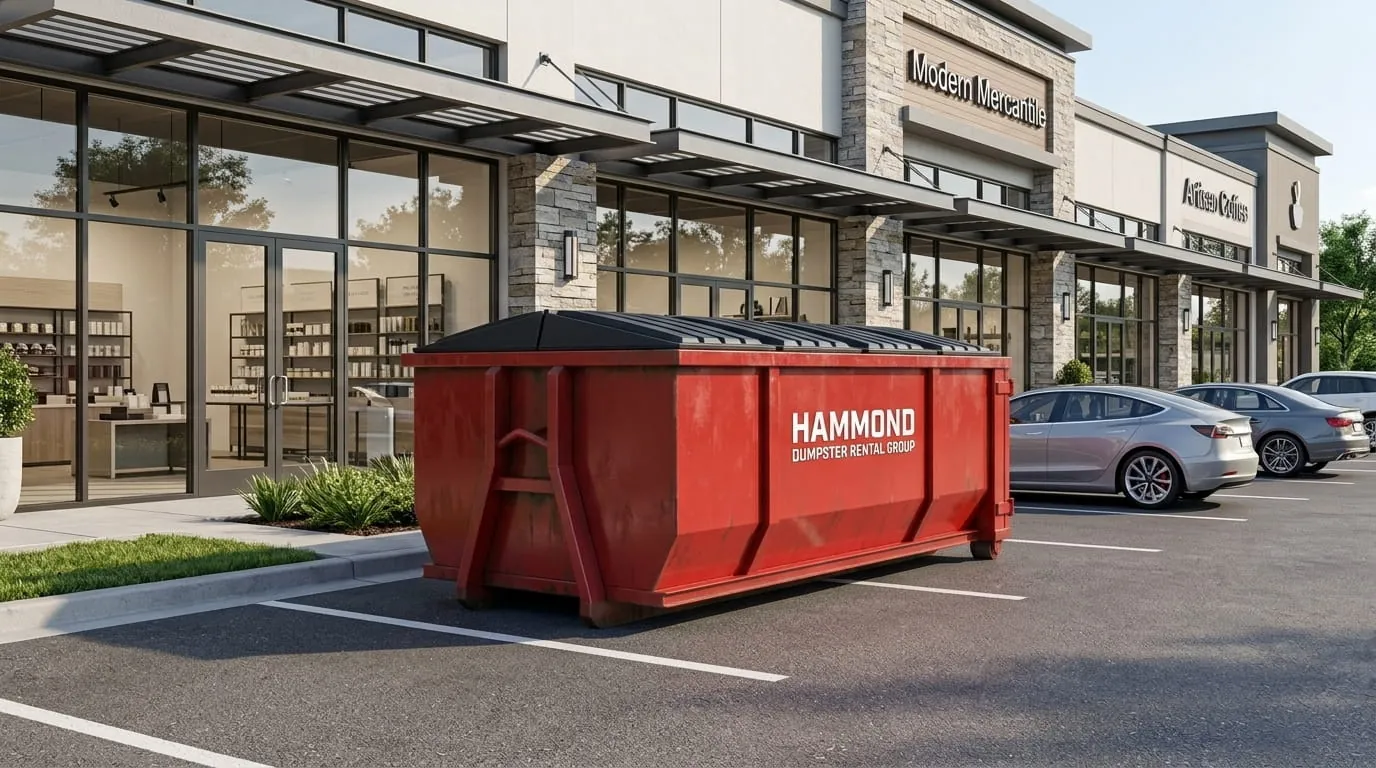
The Tangipahoa disposal chain
Understanding where material goes is not academic. It determines your disposal cost, and on a large job the difference between a thoughtful setup and a careless one runs into real money.
The centre of the chain for this parish is the Tangipahoa Parish Landfill, located on Hano Road just outside Independence and operating under a Louisiana Department of Environmental Quality permit. From Hammond it is a straight run north — up Interstate 55 to the Independence exit, west on LA Highway 40, and Hano Road is on the right. Our drivers are there several times a day.
Because we are close to it, turnaround is quick. If you fill a container and need a swap, the round trip is short enough that we can often do it the same day — which is not true of every hauler operating in this area, and it is one of the practical advantages of using a company actually based in the parish.
What the parish landfill takes
The facility accepts household solid waste, Type II waste which includes non-friable asbestos, and Type III waste, which is the classification covering construction and demolition debris. That last one is what most of our loads are.
A few operational points worth knowing, because they occasionally affect your job:
- Residential rates require proof of parish residency — a Louisiana driver's licence showing a parish address. Commercial vehicles are charged the commercial rate regardless.
- Paint must be dried out with the can cover off. This is stated plainly at the facility and it is worth passing on to anyone loading your container.
- Heavy rain can make conditions unsuitable for tipping. It is an active working face on Louisiana clay, and after a serious downpour access is sometimes restricted. This is the main reason a swap occasionally takes longer than we would like in a wet week.
Waste types and why the classification matters
Louisiana classifies solid waste by type, and the classification determines which facility can receive it and what it costs. Broadly:
- Type I — industrial waste
- Type II — municipal solid waste, including non-friable asbestos at permitted sites
- Type III — construction and demolition debris, plus woodwaste and yard trash
The practical consequence is that a clean Type III load is cheaper to dispose of than a mixed load that has to be handled as municipal waste. Throw a few bags of household trash into a container of clean demolition debris and you have reclassified the whole load upward. That is not the facility being awkward — it is how the permits work.
Friable asbestos is a different matter entirely and cannot go in our containers under any circumstances. Any building here predating about 1980 should be treated as suspect until surveyed — floor tile, mastic, pipe lagging, textured ceilings and some siding products are the usual culprits. Abatement is a licensed activity with its own disposal route.
Why stream separation saves money
Disposal is priced per ton and the rate varies by stream. Mixed C&D is the most expensive category, because the facility has to handle an unpredictable mixture. Clean inert material and clean vegetation are cheaper. Scrap metal has positive value.
Consider a demolition producing eight tons of broken concrete and eight tons of mixed debris. All in one container and you have sixteen tons at the mixed rate. Split it and you have eight tons of clean inert material and eight at the mixed rate. Even after paying for a second container movement, the split is usually cheaper — and on jobs with more concrete, considerably cheaper.
The break-even is roughly this: if you have enough of a clean stream to substantially fill a dedicated container, separate it. If it is a wheelbarrow load, do not bother.
The five streams worth separating
1. Clean concrete, block and masonry
Rebar is generally fine. Timber, plastic sheeting, soil and general debris are not. Goes in a 10 yard because of weight, always.
2. Scrap metal
Copper pipe, steel studs, ductwork, appliances, conduit, rebar offcuts — and out in the rural parts of this parish, barn roofing sheet, gates, panels and old implements. On a farm demolition the metal alone is often worth setting aside.
3. Clean dimensional lumber
Untreated, unpainted, fasteners removed where practical. On a framing job this is a large proportion of the waste stream. Note that treated timber does not qualify, which matters here because deck, pier, dock and fence timber is nearly always treated.
4. Cardboard and packaging
New construction generates an extraordinary amount — appliance boxes, fixture packaging, banding, shrink wrap. On a multi-unit build a dedicated container makes sense.
5. Clean vegetation
Land clearing, tree removal, site prep. Common on the acreage work out toward Robert, Loranger and the rural parish. Keep soil out of it as far as practical, because soil weight is what ruins a vegetation load's economics.
Sizing for construction debris
Two rules, pulling in opposite directions.
Framing, drywall, packaging and general build waste: go big. A 30 yard, with swap-outs planned into the programme. This material is bulky and light, so you fill the volume long before the weight allowance.
Concrete, block, brick and tile: go small. A 10 yard, filled between half and two-thirds. A cubic yard of concrete is around two tons; the arithmetic does the rest.
Most real jobs need both at different phases, which is why we would rather talk through the programme than take a single order.
One more consideration specific to this region: anything that has been wet. Flood remediation and post-storm work produce saturated drywall, insulation and flooring that weighs a multiple of its dry equivalent. Size those jobs by weight, not by volume, or the overage will surprise you.
Documentation and weight tickets
If you are working to a specification that requires waste documentation, or a client who wants evidence of responsible disposal, ask for weight tickets. Every load through a licensed facility generates one showing the tonnage and the receiving site.
Separated streams make that reporting straightforward, because a clean concrete or clean metal ticket is unambiguous evidence of diversion. Mixed C&D tickets tell a much less useful story.
Practical site setup
- Place containers where the work is, not where they are convenient for the truck. Labour spent walking debris across a site is the largest hidden cost in waste handling.
- Label them, even crudely. A sheet of plywood marked CONCRETE ONLY prevents a great deal of expensive contamination.
- Brief the trades. One subcontractor throwing a lunch bag and a paint can into the clean concrete container costs more than the briefing would have.
- Book swaps into the programme, not on the day you notice the can is full.
- Watch the weather, twice over. An open container through a Louisiana wet week gains real weight, and heavy rain can also restrict tipping at the landfill. Cover heavy loads and build a little slack into the schedule in storm season.
- Mind the ground. Clay subgrade that carried a loaded truck in October will not necessarily carry one in March. On unpaved sites, have a firm standing point in mind.
None of this is complicated. It is mostly about deciding the plan before the first container arrives rather than improvising when the site is already busy. We are happy to help set that up — tell us the build programme and we will schedule around the trade sequence.
Need a container in Hammond?
Call and describe the job. Three minutes on the phone gets you a size recommendation, a flat rate and a delivery window — and we will tell you if a smaller, cheaper container is the right answer.
Call (985) 602-2751